Repository navigation
How could I obtain 2 or more observation points at a single iteration? #340
Description

Dear guys:
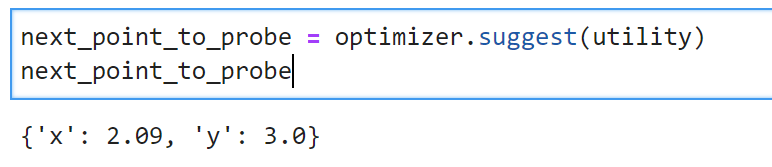
I found that the function "next_point_to_probe = optimizer.suggest(utility)" can only give one suggesting observation point. However, in my experiment, I want 5 observation points during each iteration.
How could I fix that?
Activity
bwheelz36 commentedon Jul 27, 2022
interesting question, which was also asked in #327 (I closed that because no one was writing back but possibly should have left it open!).
I think maybe at the moment you can't do this.
In principle you could add a parameter to suggest like n_suggest=5, and based on some criteria get back the five best candidates. But figuring out what this criteria should be could be tricky.
One option could be choose the five best points based on increasingly exploratory weighting in the acquisition function... e.g. in UCB, say the user has kappa =5 and requests n_suggestions, you could do something like:
But it would need some work on this feature, which to be clear I don't have time to do! But pull requests are welcome...
UCASAlbert commentedon Jul 28, 2022
Thanks a lot. I will try this and come back to tell the results.
UCASAlbert commentedon Jul 28, 2022
@bwheelz36
thanks a lot. I fix this point by writing a new function "acq_max_plus" in the source code util.py as following:
the logic is to give out the points with 'top n_suggestion' acquisition function values.
bwheelz36 commentedon Jul 28, 2022
ok, glad it worked - I will close this now then :-)
bwheelz36 commentedon Aug 17, 2022
Hey @UCASAlbert see #347 - I hadn't thought of this but essentially you could create a temporary acquisition function and use the kappa decay functionality to get multiple suggestions
means-to-meaning commentedon Jan 20, 2024
Perhaps a silly question, but my first go to idea would not be to use 5 different kappas, but take n local maxima from the given utility function. This would not work in later stages of the optimization where there is one dominant candidate location though..
bwheelz36 commentedon Jan 23, 2024
Hey @means-to-meaning,
the underlying gaussian process has both an estimate and and uncertainty for the objective function at each point. kappa defines how you choose to trade off these two things - you can choose a highly uncertain point (high kappa) or ignore uncertainty and pick a point with a high predicted value (low kappa). The other issue with "n local maxima" is that n local maxima may not exist.
Having said this, ultimately this behavior only makes sense if you are able to do parallel optimization, and in that case you should see #347 for a much better thought out approach.